The hackathon is supported by IBM-IISc Hybrid Cloud Lab and IndiaAI Mission of the Ministry of Electronics and Information Technology, and sponsored by Cisco Corporate Social Responsibility.
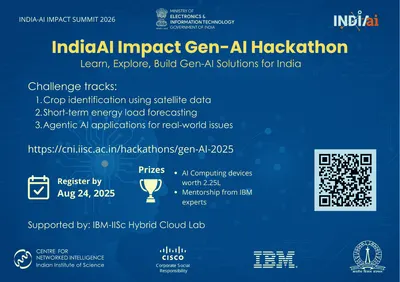
The objective of this hackathon is to spur the development of AI-driven solutions for the Indian context, harnessing the power of open-source technologies among Indian students. To help participants climb the learning curve swiftly, we will provide starter resources—online learning resources, boilerplate code, and datasets—powered by IBM. IBM offers many open-source tools to build Gen AI Solutions. These resources can help you with setting up data preprocessing pipelines, handling of unstructured data, creation of synthetic data towards fine-tuning, and running the fine-tuning process. The Agent Development Kit (ADK) can help with building Agentic Applications equipped with Gen AI models.
Find out more at hackathon challenge tracks.
Updates
- We've received a very enthusiastic response to the hackathon, exceeding 3000 registrations so far. To allow more students to participate, we have extended the rgistration date to August 30.
However, the deadline for submission of proposals on DevPost will remain August 30, 11pm. - Participants must fill up the participant details Google form (link sent to all registered participants) individually and submit the project proposal (per team) by the deadline to proceed further.
Participation
Who can participate?
This hackathon is open to all college students currently enrolled in a full-time academic program in India. You can participate as an individual or as a team of up to three members.
How to participate?
- Form a team and register at DevPost.
All team members will need to register on DevPost. Post registration, you'll receive an email confirmation and a link to a form for submitting additional participant details. You'll also need to provide the kaggle ID of all team members for further instructions. - Go through the challenge tracks carefully and pick the track that you'd like to attempt. Accordingly, update your submission on DevPost with your proposal details. Please ensure that you provide the exact description of the solution that your proposing and the approach.
- We'll review your proposals on completeness and select the proposals that meet selection criteria. If your proposal is approved, you'll receive an invite from Kaggle to enter the track-specific workspace. Depending on the track you've picked, you'd either be able to develop/test your solution on Kaggle itself (track-1 and track-2), or will need to set up a local development environment (track-3).
- Once you finalise the solution, you'll be required to upload your solution to a GitHub repository. We'll be sending a GitHub Classroom invite for every team.
Important deadlines (all times in IST)
- Registration of teams on DevPost starts: August 14, 2025
- Registration of teams on DevPost closes:
August 24, 2025August 30, 11 pm - Proposal submission on an online form: 11 pm, August 30, 2025
- Notification of proposal approval and Kaggle invite to approved participants: September 04, 2025
- Final solution submission on GitHub: 11 pm, September 15, 2025
- Winners announcement: September 21, 2025
Prizes
- The top three teams in each track will receive prizes in the form of compute devices. The total prizes per track will be worth INR 75K.
- The winners from each track will also receive mentorship from IBM experts, and will receive an opportunity to apply for an externship at IBM Research.
- All participants with valid submissions will receive a participation certificate.
Hackathon tracks
Track 1: Crop identification using satellite data
Crop identification using satellite observations is an age-old problem and remains challenging, especially when trying to generalize model predictions across India's fragmented small farms with diverse cropping practices. This situation is different from regions like the USA or Europe, where farms are larger and practices are more homogeneous. Therefore, there is a significant opportunity to contribute by using geospatial foundation models as a backbone, fine-tuned with Indian native satellite observations and field-collected label data for a variety of crops. In this hackathon, the goal is to classify crop types in agricultural fields across Northern India using a combination of SAR and multispectral observations from Sentinel-1/EOS-4, ResourceSAT-2/2A, and Sentinel-2 satellites. Fields are located in various districts across the states of Uttar Pradesh, Rajasthan, Odisha, and Bihar. The AgriFieldNet India training dataset was originally generated by the Radiant Earth Foundation using ground reference data collection, and the IBM Research team enhanced it by adding SAR and optical observations from ISRO and EPA satellite sources.
Track 2: Short-term energy load forecasting
Accurate short-term load forecasting is crucial for decarbonizing buildings, which contribute about one-third of global energy use and emissions. This task focuses on forecasting and anomaly detection for energy consumption in commercial and residential buildings, supporting efficient energy management, renewable integration, and reduced reliance on fossil fuels. You will work with pre-trained Time Series Foundation Models (TSFMs) that learn generalizable temporal patterns across domains, enabling accurate forecasts and anomaly detection for new buildings without retraining. You can also fine-tune these models for specific building types or operational needs.
Track 3: Agentic AI applications for real-world issues
This track offers an opportunity to explore innovative use-case scenarios leveraging IBM's open-source technologies, including the Granite series of models, data preprocessing and preparation toolkits, performance benchmarks, and agent development frameworks. You are encouraged to propose end-to-end user scenarios that demonstrate complete automation workflows powered by Generative AI technology assets. This is your chance to showcase functional AI agents and articulate their end-value proposition through practical demonstrations. Consider drawing inspiration from India-centric scenarios where automation can address critical needs and deliver meaningful impact. IBM provides a comprehensive suite of technology assets (tech assets) and development tools, including the Agent Development Kit (ADK) for building agentic workflows.
Contact
For any queries, please reach out to us at admin@cnihackathon.in.