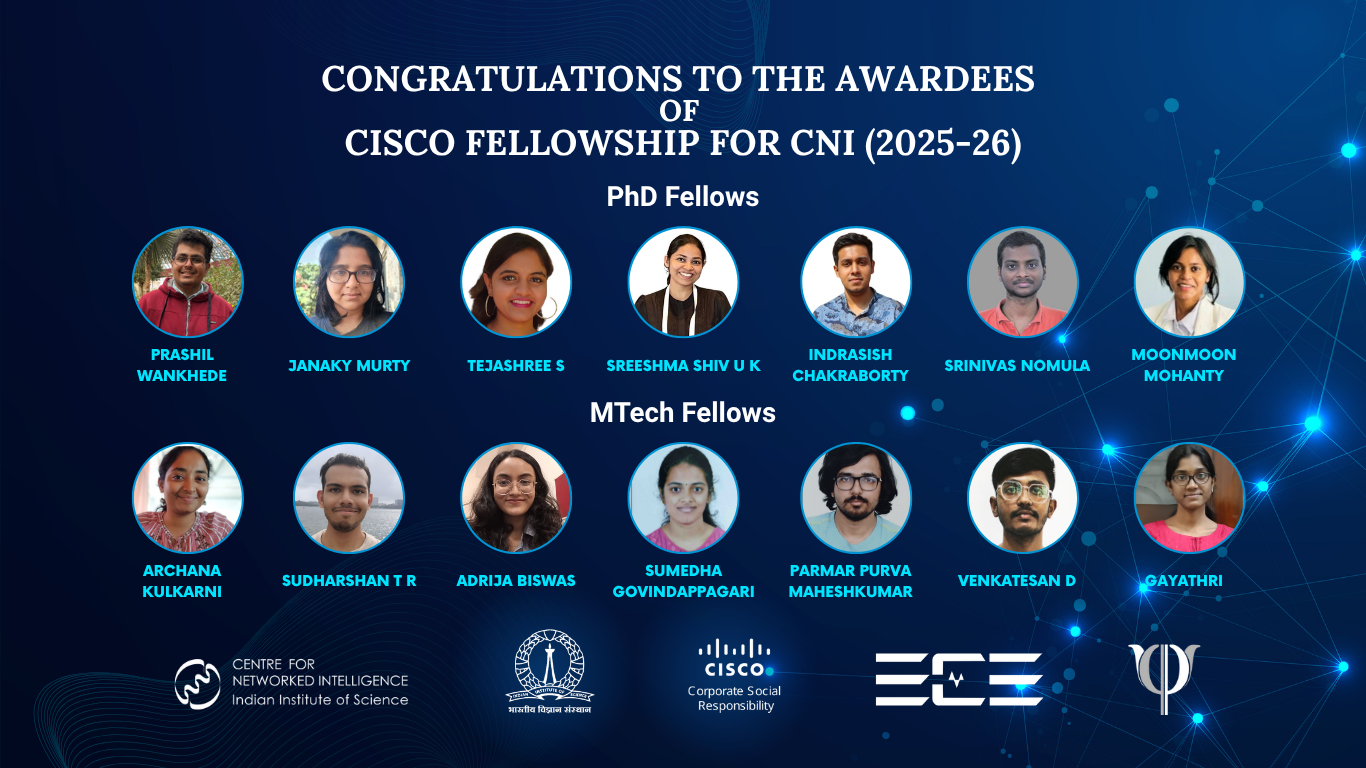
01 Nov 2025 | The Awardees of Cisco FellowshipCNI Awarded Fellowship to 7 PhD and 7 MTech Students |
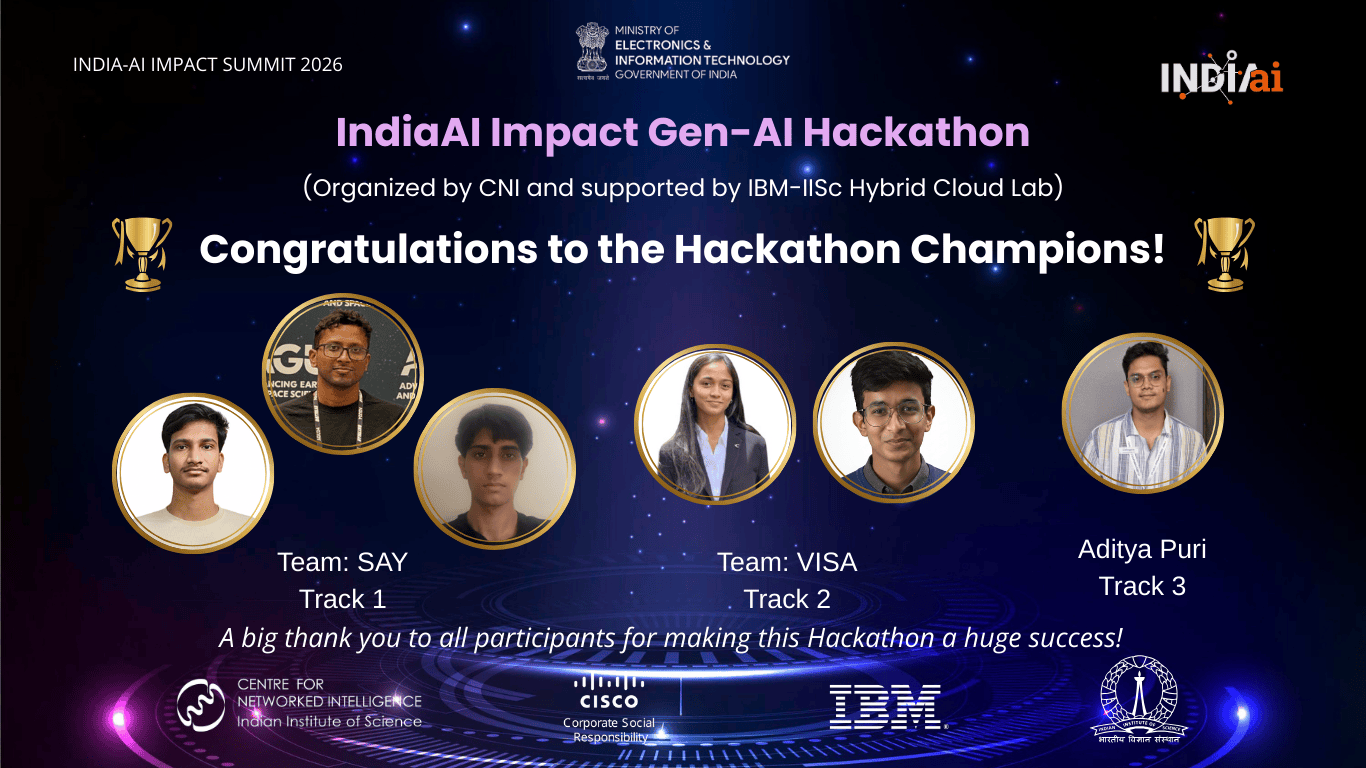
26 Sep 2025 | IndiaAI Impact Gen-AI HackathonIndiaAI Impact Gen-AI Hackathon results announced. |
23 Sep 2025 | CodeIT: CNI Workshop on Codes, Sequences and Information TheoryCelebrating Vijay@70. |
01 Sep 2025 | IISc Centenary LectureLife and Random Algorithms by Prof. Bruce Hajek |
03 Mar 2026, 12:00 PM — 1:00 PM
GJ Hall and Online on Zoom Zoom link: https://us06web.zoom.us/j/83388976389?pwd=XcpO3GhLxsR14a7SVbPx33HQQa1jbt.1
Dear All, Networks Seminar, supported by the Centre for Networked Intelligence, is a technical discussion forum in topics including but not limited to computer networks, machine learning, signal processing, and information theory. The seminar series has a webpage hosted at https://cni.iisc.ac.in/seminars/. You are invited to the following seminar held as part of this series. Title: Manifold Optimization in Data Science Speaker: Prof. Max Pfeffer, Junior Professor, Georg-August-Universität Göttingen Time: 12:00 PM - 1:00 PM (IST) Date: 03 March 2026 Venue: GJ Hall and Online on Zoom Zoom link: https://us06web.zoom.us/j/83388976389?pwd=XcpO3GhLxsR14a7SVbPx33HQQa1jbt.1 Zoom Meeting ID: 833 8897 6389, Pass Code: NSSIISc YouTube Livestream: https://www.youtube.com/watch?v=Jp_Su0ejDFc Webpage Link: https://cni.iisc.ac.in/seminars/2026-03-03/ <https://cni.iisc.ac.in/seminars/2026-03-03/> Abstract: Matrix and tensor factorizations are widely applied in Data Science for dimensionality and noise reduction as well as for feature extraction. Often, additional constraints are imposed on the factors in order to improve the uniqueness and interpretability of the results. We consider several specific factorization formats with smooth and nonsmooth constraints that can be computed using techniques from Riemannian optimization. For this, existing methods need to be adapted according to the problem at hand. Furthermore, we apply our methods also for Data Fusion, where several data sets are factorized simultaneously. Bio: Dr. Max Pfeffer is a Junior Professor of Mathematics at Georg-August-Universität Göttingen since April 2023. Prior to this, he held research and academic positions at SimulaMet (Oslo), Technische Universität Chemnitz, Johannes Gutenberg University Mainz, Universität Leipzig, and the Max Planck Institute for Mathematics in the Sciences in Leipzig. He completed his PhD in Mathematics at TU Berlin in 2018, where he also earned his M.Sc. and B.Sc. degrees. His research interest is in tensors, Riemannian optimization and applications. More details: https://sites.google.com/view/maxpfeffer/ ALL ARE WELCOME. Thank you, CNI Seminar Series Organizing Committee.
03 Mar 2026, 5:30 PM — 6:30 PM
GJ Hall and Online on Zoom Zoom link: https://us06web.zoom.us/j/83388976389?pwd=XcpO3GhLxsR14a7SVbPx33HQQa1jbt.1
Dear All, Networks Seminar, supported by the Centre for Networked Intelligence, is a technical discussion forum in topics including but not limited to computer networks, machine learning, signal processing, and information theory. The seminar series has a webpage hosted at https://cni.iisc.ac.in/seminars/. You are invited to the following seminar held as part of this series. Title: Multi-community Spectral Clustering for Geometric Graphs Speaker: Prof. Hariprasad Manjunath, Assistant Professor, Chanakya University Time: 5:30 PM - 6:30 PM (IST) Date: 03 March 2026 Venue: GJ Hall and Online on Zoom Zoom link: https://us06web.zoom.us/j/83388976389?pwd=XcpO3GhLxsR14a7SVbPx33HQQa1jbt.1 Zoom Meeting ID: 833 8897 6389, Pass Code: NSSIISc YouTube Livestream: https://www.youtube.com/watch?v=FMNhg32GRPo Webpage Link: https://cni.iisc.ac.in/seminars/2026-03-03-1/ <https://cni.iisc.ac.in/seminars/2026-03-03-1/> Abstract: This talk presents recent advances on community detection in geometric random graphs under the Soft Geometric Block Model (SGBM). The SGBM extends the classical Stochastic Block Model by incorporating spatial structure: vertices are randomly embedded in a compact metric space, and edge probabilities depend both on community labels and geometric distance. In such settings, classical spectral clustering methods that rely on the largest or smallest eigenvalues often fail, since those parts of the spectrum are dominated by geometric effects rather than community information. We introduce a higher-order spectral clustering algorithm for the dense regime with a fixed number k≥2 of equal-sized communities. Instead of selecting extreme eigenvalues, the algorithm targets the k−1 eigenvalues closest to a theoretically predicted value determined by the difference between intra- and inter-community connection probabilities. The associated eigenvectors provide an embedding into Rk−1, after which k-means clustering is applied. We prove spectral separation of these informative eigenvalues, characterize the limiting spectral distribution of the adjacency matrix, and establish weak consistency of the algorithm, together with strong consistency after a simple local refinement step. A key ingredient is a non-standard application of the Davis–Kahan theorem to control eigenspace perturbations when eigenvalues are not simple. Finally, we present a conjecture concerning spectral seriation for community recovery in one-dimensional geometric graphs. In this setting, we hypothesize that appropriate spectral ordering methods can recover the latent geometric arrangement of vertices and thereby reveal community structure. This conjecture suggests a deeper connection between geometry, spectral ordering, and clustering, and points toward new directions for understanding community detection in low-dimensional geometric networks. Bio: Dr. Hariprasad Manjunath is an Assistant Professor at the School of Mathematics and Natural Sciences, Chanakya University, Bengaluru. He received his Ph.D. in Computational and Data Science from the Indian Institute of Science (IISc), Bengaluru, in 2022, where his research focused on fast algorithms for eigenvalues of periodic matrices. His research interests include spectral graph theory, matrix analysis, numerical linear algebra, and geometric random graphs. He has previously served as a Postdoctoral Researcher at INRIA, France, and as an Assistant Professor at IIIT Dharwad. More details: https://chanakyauniversity.edu.in/faculties/hariprasad-manjunath-hegde/ ALL ARE WELCOME. Thank you, CNI Seminar Series Organizing Committee.
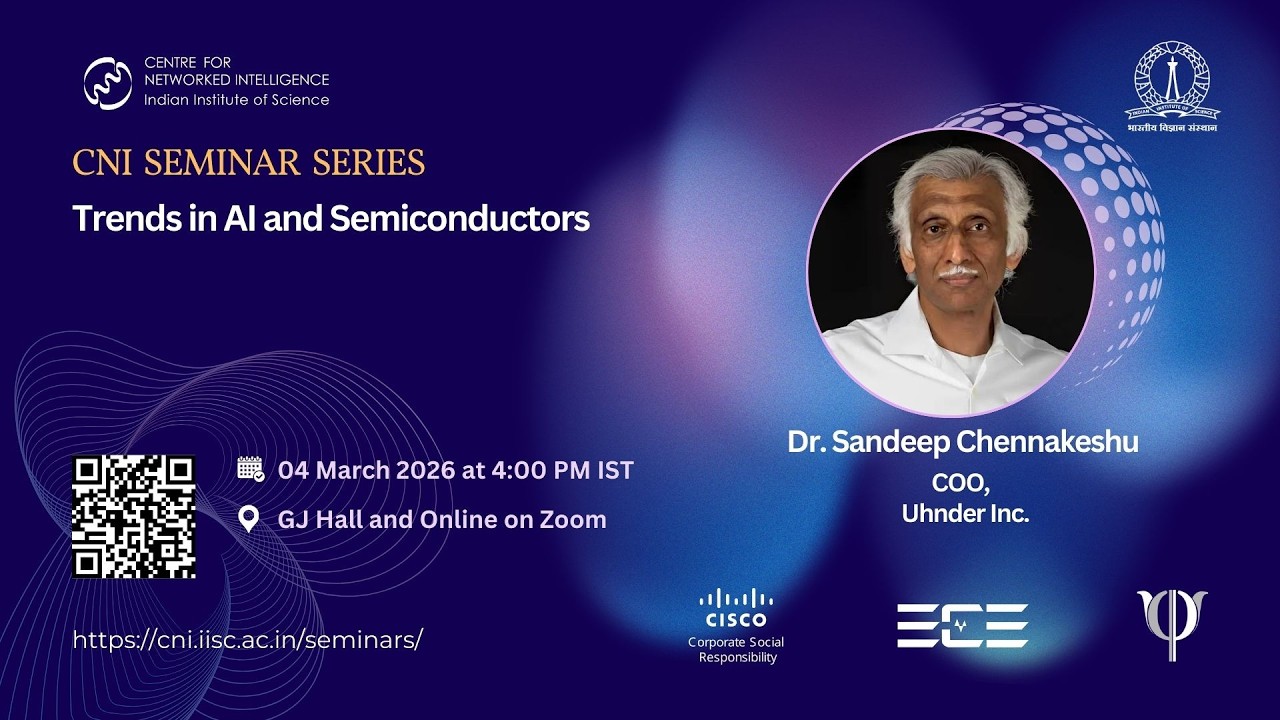
04 Mar 2026, 4:00 PM — 5:00 PM
GJ Hall and Online on Zoom Zoom link: https://us06web.zoom.us/j/83388976389?pwd=XcpO3GhLxsR14a7SVbPx33HQQa1jbt.1
Dear All, Networks Seminar, supported by the Centre for Networked Intelligence, is a technical discussion forum in topics including but not limited to computer networks, machine learning, signal processing, and information theory. The seminar series has a webpage hosted at https://cni.iisc.ac.in/seminars/. You are invited to the following seminar held as part of this series. Title: Trends in AI and Semiconductors Speaker: Dr. Sandeep Chennakeshu, COO, Uhnder Inc. Time: 4:00 PM - 5:00 PM (IST) Date: 04 March 2026 Venue: GJ Hall and Online on Zoom Zoom link: https://us06web.zoom.us/j/83388976389?pwd=XcpO3GhLxsR14a7SVbPx33HQQa1jbt.1 Zoom Meeting ID: 833 8897 6389, Pass Code: NSSIISc YouTube Livestream: https://www.youtube.com/watch?v=blqu7wBC27M Webpage Link: https://cni.iisc.ac.in/seminars/2026-03-04/ <https://cni.iisc.ac.in/seminars/2026-03-04/> Abstract: AI, enabled by impressive advances in semiconductors, has started to transform industries and societies. In this talk we will begin by exploring the AI eco-system, the challenges and opportunities and highlight why system knowledge is critical for leadership. Next, we will dive deeper into semiconductor advances as it relates to AI, including the eco-system dependencies, evolution of transistors, memory, computational architectures, interconnects, and packaging. Finally, we will summarize the impacts of these advances on R&D costs. The talk concludes by summarizing what is essential for product development and a personal view on opportunities for Indian product companies. Bio: Dr. Sandeep is the former CTO of Ericsson Mobile Phones/Sony-Ericsson, President Ericsson Mobile Platforms, SVP Freescale, President Blackberry Technology Solutions, EVP AMD and COO Uhnder Inc. Over his 37 year career he led teams that built pioneering products used widely across the world -- multiple generations of 2G-3G modems and cellphones, Bluetooth, the first mobile-satellite air-interface, semiconductor chips and mission critical software for consumer, automotive, medical and industrial applications. He is also the inventor of the asset tracking IoT system called BlackBerry Radar that is used for freight transportation across North America. Along this journey he was granted over 250 patents and wrote an award-winning management book titled “Your Company Is Your Castle” that captures his experience of successfully transforming multinationals to become market leaders. More details: https://sandeepchennakeshu.com/ ALL ARE WELCOME. Thank you, CNI Seminar Series Organizing Committee.
We are racing towards a connected world where every individual and device contribute to and benefit from the network. However, our data collection surpasses our ability to extract valuable knowledge. To achieve networked intelligence, we need a holistic approach involving real-time sensing, communication, analytics, and more. The centre aims to develop next-gen networking solutions for smart cities, IoT, data exchanges, and society's benefit.